Scriptor: Write it in your own words. Restore it before the ink fades.
We forget most of what we learn within days. Scriptor asks you to write it down in your own words, then lets the ink fade until you bring it back.
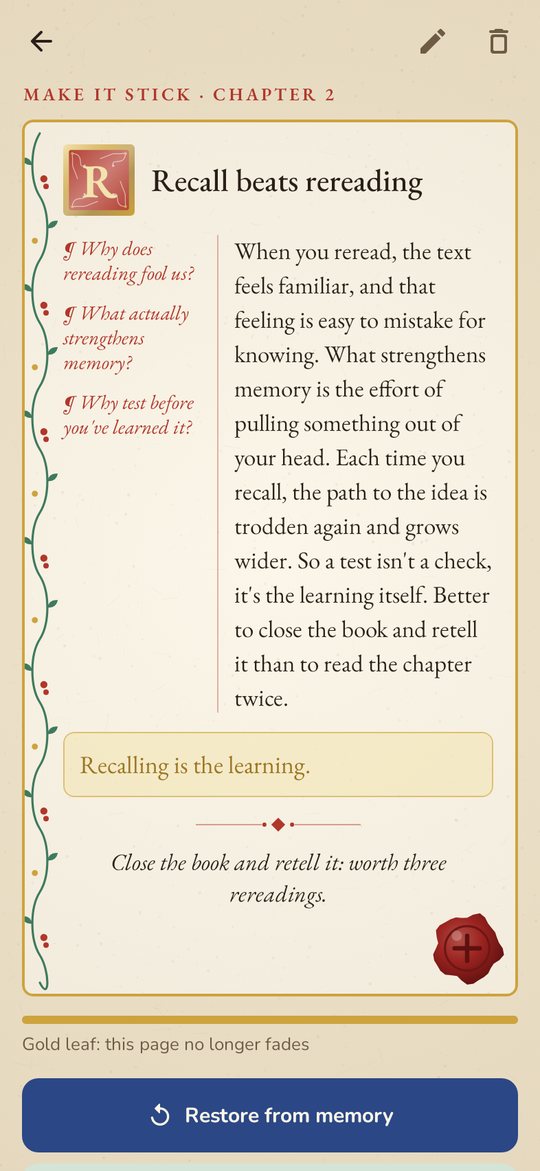
After a book, a lecture or a video, close it and write a page in your own words. The page fades along your own forgetting curve, and you bring the ink back by writing it again from memory, answering the questions on its margin or filling the words the mice ate. Understood pages earn an initial, vines, gold leaf and a seal. Free, no ads, no account, no network.
Download the APK · Stillcraft page · Source on GitHub
What’s inside
A page in your own words
A codex for each book, video, article, podcast, lecture or course, begun with a preface of what you expect and questions to the source. Pages are laid out the Cornell way: questions on the margin, a golden line, a colophon. Pasted text goes aside as the author’s words, and you can tell it aloud instead.
Ink that fades like memory
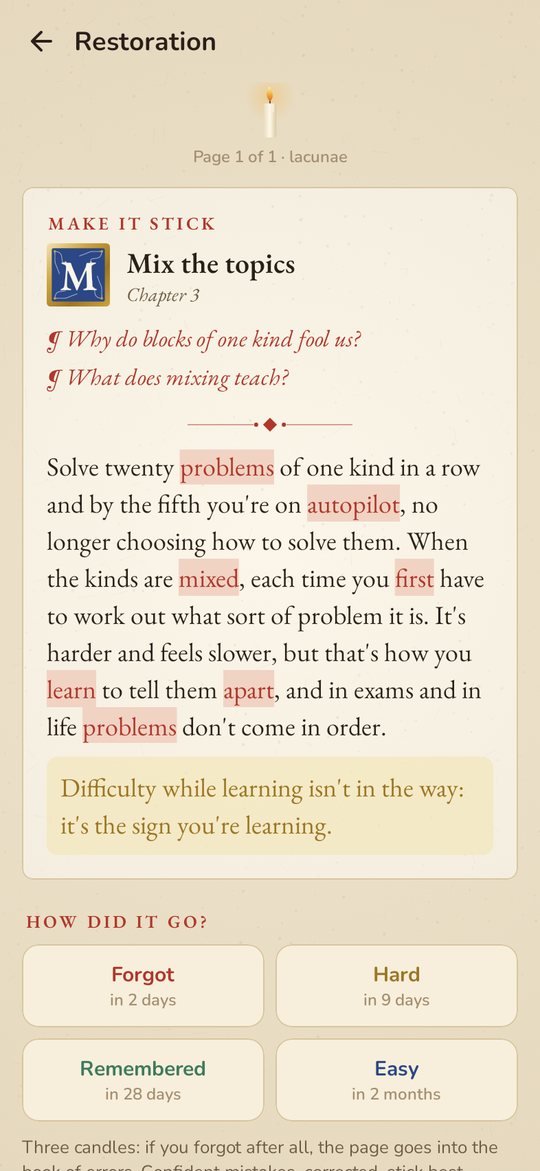
Each page fades along its own forgetting curve (FSRS). Restorations take turns: rewrite it from memory, answer the margin, fill the lacunae, redraw the miniature. What you missed shows in cinnabar, and your grade bends the curve.
Candles and the book of errors
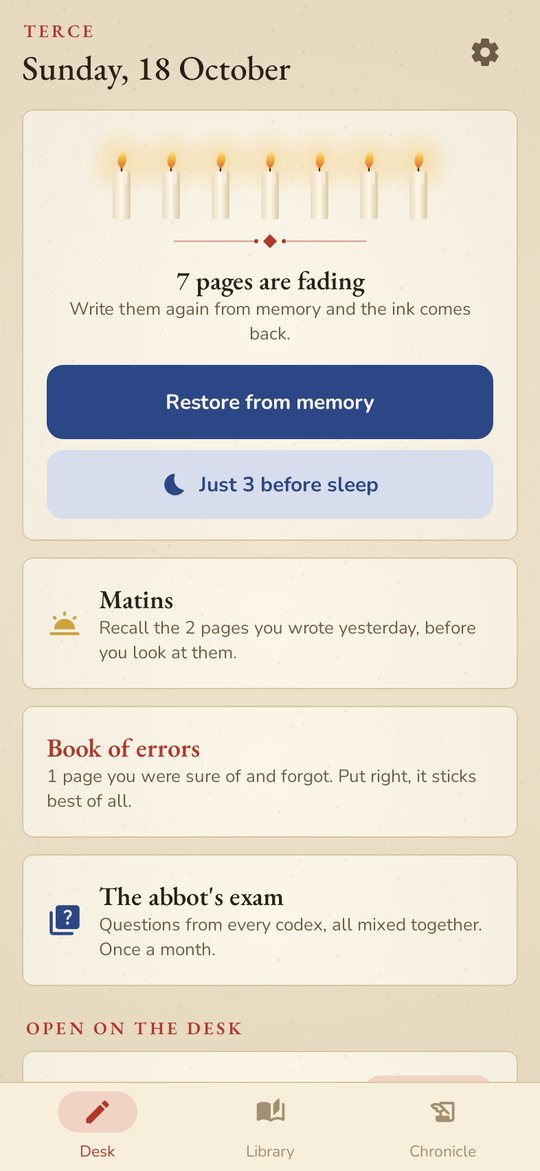
Before you look, stake one to three candles on being right. Mistakes made with three candles go into the book of errors, and the scribe’s eye shows how well your confidence matches what you know.
The novice and the margins
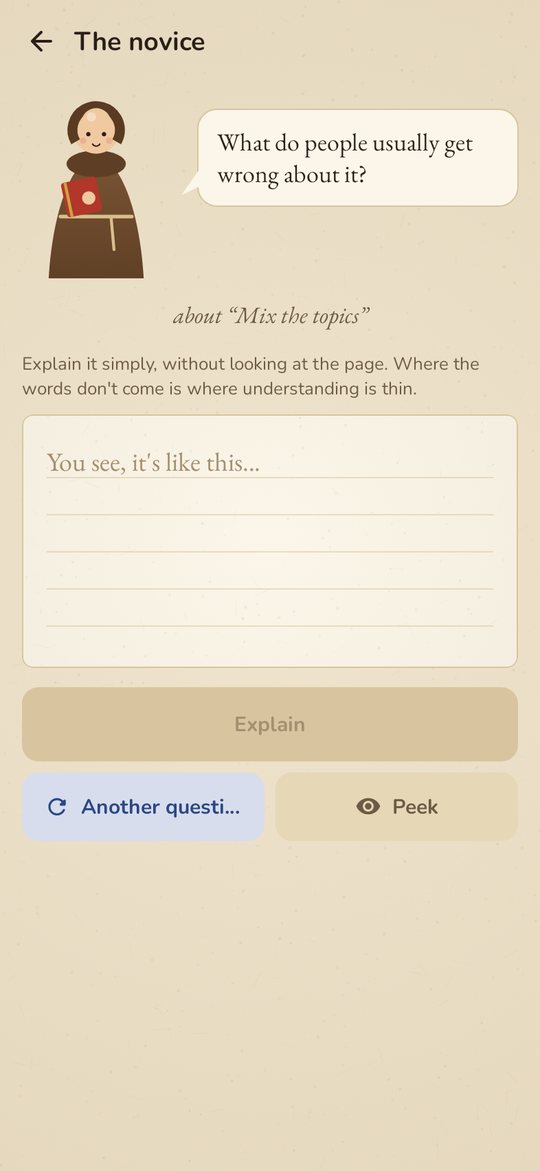
A novice asks why, for an example, how to tell it to a ten-year-old. On the margins: examples from your life, parables, a dispute with the author, a disputation of thesis and objections, and the seal of practice once you’ve used it.
Matins and Compline
Two bells a day, only when there’s something to do: in the morning, recall what you wrote yesterday; before sleep, restore a few fading pages. Close a codex in one sentence and three words tooled on its spine.
Crafts that open as you go
A new scribe starts with ink alone. Later come miniatures drawn by hand, red threads between books with their map, the abbot’s monthly exam of mixed questions, and the monastery of memory, where ideas wait in its places for a walk.
The learning science inside
| Technique | In Scriptor |
|---|---|
| Generation effect | Pages in your own words; pasted text goes to quotations |
| Retrieval and spacing | Fading ink, restorations scheduled by FSRS |
| Varied retrieval | Recall, margin questions, lacunae and miniatures in turn |
| Pretesting, Cornell notes | The preface, questions to the source, the cue column, the colophon |
| Feynman technique | The novice who asks for plain words |
| Metacognition, hypercorrection | Candles staked before looking, the book of errors, the scribe’s eye |
| Sleep consolidation | Compline before sleep, Matins in the morning |
| Interleaving | The abbot’s exam: mixed questions, first tell which book |
| Method of loci | The monastery of memory and its walk |
Good to know
How is it different from flashcards?
You don’t copy facts onto cards; you explain a whole idea in your own words and later rebuild it from memory. The schedule is the same kind that flashcard apps use (FSRS), but what you practise is understanding, not one-line answers.
Does it check my answers?
When you write a restoration, Scriptor compares it with the page word by word and marks what you left out, then suggests a grade. The last word is yours: you can also recall in your head and grade yourself.
Is it religious?
It borrows the look and the words of a medieval scriptorium: codices, rubrics, Matins and Compline. Nothing in it asks you to pray; the hours are just a morning and an evening bell.
What if I change phones?
Settings → Backup saves everything, pages, margins, threads and the monastery, to one JSON file. Restore it on the new phone.
Get it
- Requires: Android 8.0 (API 26) or newer. No Google services needed.
- Permissions: Notifications for Matins and Compline. Speaking aloud goes through the phone’s own recogniser. No internet.
- License: MIT
- Download the APK on your phone.
- Open it and allow installs from this source when Android asks.
- Bind a codex for what you’re reading or watching, then close it and write the first page from memory.
Download the APK · Stillcraft page · Source on GitHub
Scriptor is part of Stillcraft, a shelf of small, free, open-source apps for everyday life: no ads, no accounts, and your data stays on your phone. A new one appears here every few days.

comments